Dr. Evelyn
Assistant Professor, Communicative Disorders · Eastern New Mexico University
CDIS Leveling Program FAQ
Welcome! This page is for students admitted to the CDIS leveling program at ENMU who have Dr. Evelyn as an advisor. You'll find answers to common advising questions, links to important resources, and instructions for next steps.
Please note: information in this FAQ may not be appropriate for students who aren't being advised by Dr. Evelyn.
How to find what you need: open a section below, or ask your question in the search box.
Getting Started at ENMU7 questions
How do I access my email and student accounts?
- Account setup: ssb.enmu.edu account pickup
- Portal login: my.enmu.edu
- Textbooks: ENMU Campus Store
I'm having trouble logging in, or another technical issue.
For login, password, MyENMU portal, or Canvas login problems, contact the ITS Help Desk at Portales.HelpDesk@enmu.edu or 575.562.4357 (HELP). These are technical issues the Help Desk fixes, not something I can help with.
How do I register for courses?
Log into your MyENMU portal. Click Registration, then Add/Drop Classes, and follow the prompts from there.
You can also register directly through the student registration page.
The courses I need aren't showing up when I search to register.
Usually this means the search has too many filters on it. The most common one is Course level set to Graduate. You're admitted as a graduate student, but the leveling courses are undergraduate CDIS courses, so a graduate filter hides every one you're looking for.
The fix is to search by subject and leave the other fields blank. On the class schedule search, set Subject to Communicative Disorders (CDIS) - Portales, leave everything else empty, and click Search. That lists every CDIS section for the term.
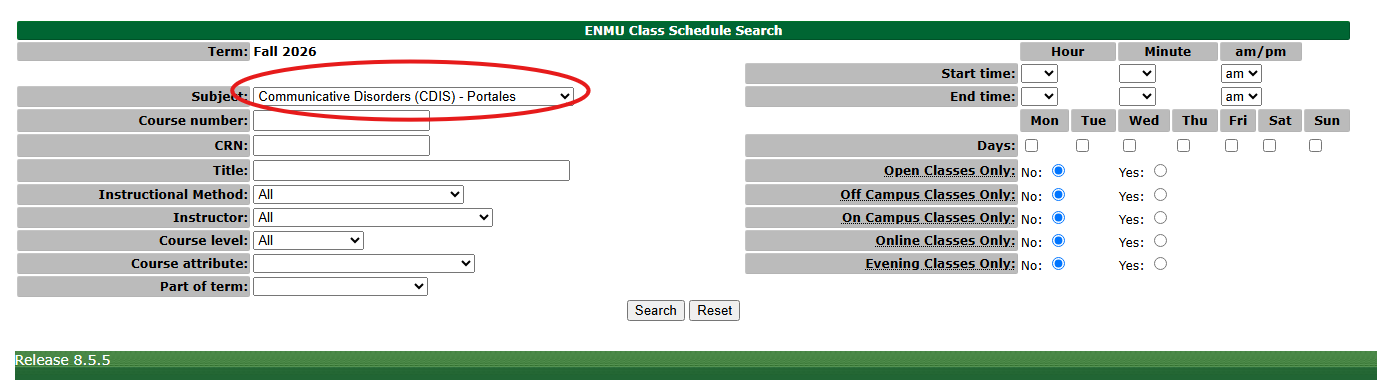
If you'd rather set Course level, set it to Undergraduate, not Graduate. Leaving it on All works too.
What is a CRN, and where do I find it?
A CRN, or Course Reference Number, is the 5-digit number that identifies one specific section of a course in one specific term. Every section has its own CRN, and the same course gets a new CRN every term, so always copy it from the current schedule rather than an old one.
To find it, look up your course in ENMU's class schedule for your term and read the CRN column. It's the first number column, just after Status.
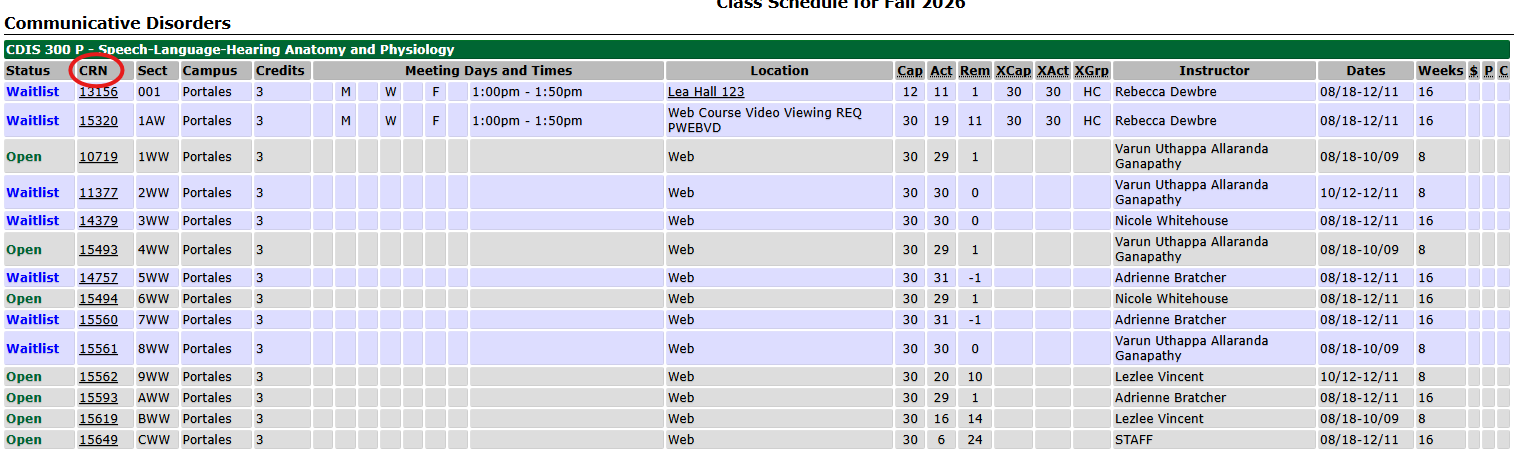
You'll need the CRN whenever you request an override or list a course on the advising form.
How do I drop courses?
There are two ways to withdraw from a class, and which one you use depends on where you are in the semester. Check the withdrawal dates for your term on the ENMU Academic Calendar before you start.
Option 1: withdraw yourself
Log into the MyENMU portal, click Registration, then Add/Drop Classes, then Register for Classes. Select the semester, find the summary box of your enrolled classes, and in the Action column on the far right choose Withdrawal/Web for the course you're dropping. Then click Submit.
Option 2: request a withdrawal
In the portal, click Registration, then Course Withdrawal Information. Download the withdrawal request form, fill it out, and email it to practicum.Forms@enmu.edu.
How to Withdraw from Classes PDF, 4 pages, with screenshots
Withdrawing may leave a W on your transcript, and it can affect your tuition balance and, if you receive aid, your financial aid. Billing questions go to Student Accounts at 575.562.2005 and aid questions to financial.aid@enmu.edu.
Why does Dr. Evelyn keep telling me to email from my ENMU account?
Because of FERPA, the Family Educational Rights and Privacy Act, I can only discuss your personal academic information through your ENMU email account. Using your ENMU email protects your privacy and confirms that I'm communicating with the correct student.
It also matters when I contact other departments on your behalf. I often need to copy you into that conversation, and I can't do that unless you're using your ENMU email.
Program Basics3 questions
Is this a certificate or degree program?
The CDIS leveling program is not a degree or certificate program. It's a flexible, non-degree path that provides prerequisite coursework for students preparing to apply to graduate school or for SLP-A licensure. You won't receive a diploma or certificate of completion, but your completed courses will appear on your ENMU transcript and can be submitted to graduate programs or state licensing boards.
ENMU does offer other programs for students who want a formal credential:
- A second bachelor's degree in Communicative Disorders
- An Associate of Science in Speech-Language Pathology Assistant (SLPA)
If you're interested in either of these options, please let me know and I'll connect you with the appropriate advisor.
Will I receive anything official when I finish?
No diploma or certificate is issued. You can request an official ENMU transcript from the registrar's office once your coursework is complete.
Where can I find more information on attending ENMU for graduate school?
You can find more information here: ENMU CDIS Graduate Program.
Course Planning and Advising11 questions
Can I schedule an advising appointment?
Submit the CDIS Leveling Advising Request form. I handle advising through the form so we have a clear record of your plan and communication.
Have this ready before you start:
- Your goal, graduate school or SLP-A licensure
- Your timeline or deadline, if applicable
- How many courses you would like to take per term
- An unofficial transcript
- If you're applying to another graduate school, their prerequisite course list
Why does Dr. Evelyn advise in writing rather than by phone or appointment?
Leveling students are non-degree-seeking, so the degree-tracking tools ENMU uses for degree-seeking students don't apply to you. Your plan is built around your own goal, timeline, and prior coursework, and I keep the record of it myself.
At any point I'm advising somewhere between 50 and 200 students. Written requests go into my advising folder, so when you come back next term with a new question I can pull up what we decided and start from there. A phone call leaves nothing to search.
That's why requests come through the CDIS Leveling Advising Request form and why I ask you to email from your ENMU account. Both keep your plan somewhere I can find it.
Are courses automatically added to my schedule?
No. You'll register for your own classes through the MyENMU Portal.
Where do I register or view holds?
- Register: Student registration
- View holds: View Holds
- Check registration status: Registration Status
Who do I contact if I can't register or I'm having a system problem?
It depends on the problem:
- A CDIS course is blocking you (prerequisite not recognized, override needed, waitlist, credit overload): submit the CDIS Leveling Advising Request form with your student ID and the course name, number, and CRN. These are the situations I can act on directly.
- A registration hold: check your holds first, then contact the office that placed it. View Holds | Registration Status
- Login, portal, or technical errors: ITS Help Desk, Portales.HelpDesk@enmu.edu or 575.562.4357.
- Online course access (Canvas): Distance Learning, distance.learning@enmu.edu.
- Transcripts, registrar processing, or forwarding an approved override: Portales.Registrar@enmu.edu.
The class I need is full, or it's waitlisted but shows open seats. What do I do?
First, check whether another section of the same course already has room. If it does, register for that one.
If there's nothing open, add yourself to the waitlist. We watch waitlist numbers to decide whether to raise a course cap or open a new section.
If a course shows as waitlisted but still lists a seat or two available, those seats are held for students who are earlier on the waitlist. When your turn comes, you have 24 hours to register before the seat passes to the next person, so watch your ENMU email.
If a new section opens while you're on the waitlist, you may be moved into it.
Can you help me plan my courses?
Absolutely! Submit the CDIS Leveling Advising Request form and include the following:
- Your goal: are you aiming for graduate school admission or pursuing SLP-A licensure?
- Your timeline and course load: when would you like to finish, and how many courses can you realistically take each term? These two go hand in hand. The number of courses you take per term directly determines how quickly you finish the program, so we'll plan them together rather than as separate decisions.
- Graduate program prerequisites: if you're applying to another graduate school, please include their prerequisite course list.
A note on transcripts
I don't need your transcript to help you plan or to keep you moving through the leveling program. There are two situations where sending one is useful:
- Prerequisite overrides: if you believe you've already completed a prerequisite course, here or elsewhere, and you're asking for permission to move into the next course, send your unofficial transcript so I can verify the prerequisite.
- ASHA general education check: if you would like me to confirm that you've met the ASHA general education requirements, send your transcript and I'm happy to review it. This is optional and isn't required to continue in the leveling program.
To aid in your course planning, refer to the CDIS Course Rotations and Suggested Course of Study page. This resource provides detailed information on course offerings, prerequisites, and scheduling.
Once you provide the above details, I can work with you to develop a personalized course plan aligned with your goals.
I'm new to the CDIS leveling program. What courses should I take?
Each course plan is unique to the student and their goals. However, most graduate programs require the following courses:
- CDIS 300, S-L-H Anatomy-Physiology
- CDIS 310, Phonetics/Phonology
- CDIS 330, Communication Development and Language Science
Many graduate programs also require:
- CDIS 301, Survey of CDIS
If you're seeking an SLP-A license in Florida or Texas, the best courses to start with are:
- CDIS 310, Phonetics/Phonology
- CDIS 330, Communication Development and Language Science
- CDIS 301, Survey of CDIS
If you're considering applying to ENMU for graduate school, you can find more information about course rotation and suggested paths on the CDIS Course Rotations page.
What's the difference between WEB, PWEBVD, and the section numbers like 001, 1AW, or 1WW?
ENMU's CDIS leveling courses are offered in a few different formats. Here's how to tell what each one means when you view the class schedule or register.
Course location terms
- WEB means the class is fully online and asynchronous.
- You do not attend live at a specific time.
- Lectures are pre-recorded and uploaded one to two times a week; the schedule depends on the instructor.
- You complete all coursework and assignments through Canvas.
- PWEBVD (Web Course Video Viewing Required) means the class is taught live on campus and recorded for online students.
- You're not required to attend live.
- You must watch the recorded class videos each week soon after they're posted.
- You may choose to attend live virtually, typically through Microsoft Teams or Zoom, but that's optional.
- Only students enrolled in the in-person section attend on campus at the scheduled class time.
- On-campus sections (for example, Lee Hall 122 or 123) are live, in-person courses.
- Register for these sections only if you live close enough to attend on campus at the designated times.
- Attendance in person is required.
Section number codes
- 001 is an in-person class on campus.
- 1WW is a web-based course, fully online and asynchronous.
- 1AW is a web course with video viewing required. These are recordings of live classes. You're required to watch the videos but not required to attend live.
Summary
| Type | Description | Attendance | Example |
|---|---|---|---|
| WEB / 1WW | Fully online, asynchronous | No live attendance required | CDIS 300-1WW |
| PWEBVD / 1AW | Live class recordings, optional live participation | Optional, must watch recordings | CDIS 310-1AW |
| 001 | In-person, on-campus | Required | CDIS 301-001 |
Every leveling course is offered online and asynchronous. On top of that, most leveling courses are also taught in person on campus at least once per academic year, and that in-person section can be attended virtually.
Graduate-level CDIS courses work differently. Almost all of them are online and synchronous, meaning you attend live at a scheduled time. That doesn't apply to leveling coursework.
You can verify the course type when registering through the MyENMU Portal.
What courses do I need to apply to ENMU's graduate program in CDIS?
These are the current CDIS prerequisites for applying to the ENMU graduate program.
Required CDIS prerequisite courses
This is the current prerequisite list. The official, authoritative source is ENMU's Graduate Program Prerequisites page; if anything here ever differs from that page, the ENMU page governs. Each course must be completed with a B or better. A course redesign takes effect FA27. Until then, where a course below is marked, a student completing it at ENMU takes the two listed courses together to cover the same content.
Required CDIS courses:
- CDIS 300, Anatomy, Physiology, and Neuroscience of Speech-Language-Hearing (available FA27 or later; before FA27 at ENMU, you need both CDIS 300 and CDIS 421)
- CDIS 301, Survey of Communication Disorders
- CDIS 310, Phonetics/Phonology and Speech-Hearing Science/Acoustics (available FA27 or later; before FA27 at ENMU, you need both CDIS 310 and CDIS 400)
- CDIS 311, Articulation/Phonology Development and Disorders: Assessment and Treatment (available FA27 or later; before FA27 at ENMU, you need both CDIS 311 and CDIS 454)
- CDIS 330, Language Development and Language Science
- CDIS 332, Language Disorders in Children: Assessment and Treatment (available FA27 or later; before FA27 at ENMU, you need both CDIS 332 and CDIS 454)
- CDIS 3XX, Clinical Methods and Professional Writing: Assessment and Treatment (meets the professional writing prerequisite; available FA27 or later; before FA27 at ENMU, you need both CDIS 441 and CDIS 478)
- CDIS 434, Aural Rehabilitation (must include basic audiology content)
- 25 observation hours (must be completed as part of CDIS 441 Lab or other university coursework; Simucase is also accepted)
The professional writing prerequisite is met by the Clinical Methods and Professional Writing course listed above.
All CDIS prerequisites for this pathway must be less than 5 years old at the time of admission.
Additional ASHA and degree requirements
These must be completed before beginning graduate clinical work, regardless of application date:
- Introduction to Statistics
- Chemistry or Physics
- General Biology
- General Sociology, or General or Developmental Psychology
These must be general education courses, not CDIS-related courses.
Important notes
- ENMU does not evaluate transcript equivalencies or confirm whether external courses count until you submit an official graduate application.
- Some prerequisite courses change with a course redesign effective FA27. The list above shows the courses that must be paired if completed at ENMU before FA27.
Full details: ENMU Graduate Program Prerequisites
Will the courses I take for SLP-A licensure also count toward graduate program prerequisites?
In most cases, yes, because the foundational CDIS courses overlap heavily. The CDIS courses required for ENMU's graduate program (300, 301, 310, 311, 330, 332, 434, and 441/441L) are largely the same ones you would take for SLP-A purposes.
One difference: ENMU's graduate program also requires a professional writing course, CDIS 478, or the combined CDIS 3XX once it's offered, which isn't required for SLP-A licensure in Texas or Florida. A student focused only on SLP-A licensure doesn't need it, while a student who may also apply to ENMU's graduate program should plan to take it. If you're applying to a graduate program other than ENMU, check that program's prerequisite list, since each program sets its own requirements.
Two things to keep in mind:
- Grades: ENMU won't admit students with less than a B in a CDIS course, and most graduate programs expect at least a B. A few programs may accept a C, but don't count on it. Aim for a B or better.
- Whether your courses will be accepted: ENMU's CDIS courses are typically accepted by graduate programs across the board. If you completed a course at another university, I can tell you whether ENMU would accept it, but I can't confirm whether the program you're applying to will. You'll need to confirm that with them directly.
If you think you might pursue a master's later, tell me now and we'll choose courses that serve both goals.
Dates and Deadlines5 questions
Where can I find the academic calendar?
All registration, semester, drop, and payment dates are posted in one place, the ENMU Academic Calendar:
When is the first day of classes?
The first day of classes for every term is on the ENMU Academic Calendar:
When can I register for classes?
Registration dates for every term are on the ENMU Academic Calendar:
When is the last day I can drop a course?
Drop and withdrawal deadlines for every term are on the ENMU Academic Calendar:
When are payments due?
Dr. Evelyn doesn't have that information. Contact Student Accounts:
- www.enmu.edu/OnlinePayments
- 575.562.2005
Tuition, Billing, and Credit Limits5 questions
How many credits can I take per semester?
Leveling students are generally limited to 12 credits per semester. In summer, the limit is 6 to 9 credits depending on GPA.
It's possible to take more than 12 credits with approval from the Dean. This is considered on a case-by-case basis, and approval is typically granted to:
- First-semester leveling students, or
- Students who have maintained a GPA of 3.5 or higher
If you would like to request an overload, register for the courses you can, then submit the CDIS Leveling Advising Request form with:
- Your ENMU student ID
- The course numbers and CRNs for the additional classes
I'll submit a request for the Dean's approval on your behalf.
What if I need to take more than the credit limit?
Register for the maximum allowed, then submit the CDIS Leveling Advising Request form with:
- Your specific request, that you're requesting an overload
- Your ENMU student ID
- The course number and CRN for any additional courses
I'll submit an override request.
If you'd rather email, here's a template you can use
Subject: Request for Credit Overload
Dear Dr. Evelyn,
I would like to take more than 12 credit hours this semester and need permission to register for an additional course. I understand this requires Dean approval, and I'm requesting your help to initiate that process.
Here's my information:
- Student ID:
- Course(s) I can't register for due to the credit limit:
- Course Name:
- Course Number:
- CRN:
Thank you for your help!
What are the tuition rules for leveling students?
Tuition for graduate leveling students is based on student classification, not the number of courses taken. To receive the $275 per credit hour rate, you must be enrolled in at least one CDIS course. If you're only taking general education courses such as biology, statistics, or physical science, you'll need to reapply to ENMU as an undergraduate non-degree-seeking student.
Who do I contact for payment or billing questions?
- www.enmu.edu/OnlinePayments
- Student Accounts: 575.562.2005
- University Directory
I have a question about financial aid.
I'm unable to answer financial aid questions. You'll need to reach out to the financial aid department.
- financial.aid@enmu.edu
- 800.FOR.ENMU
- 575.562.2194
Course Prerequisites and Labs4 questions
What if I took a required course at another university?
Submit the CDIS Leveling Advising Request form with your specific request (a course override because you took the prerequisite course at another university), your student number, and the CRN of the ENMU course you want to take. The form can't take an attachment, so email your unofficial transcript to seana.evelyn@enmu.edu from your ENMU account. I'll determine if an override is possible and request one.
If you'd rather email, here's a template you can use
Dear Dr. Evelyn,
I would like to register for a course at ENMU that requires a prerequisite I have already completed at another institution. Since the system isn't recognizing that course, I'm requesting an override to register.
Here's my information:
- Student ID:
- Course I want to register for:
- Course Name and Number:
- CRN:
- Prerequisite I completed elsewhere:
- Course Name:
- Attached: Unofficial transcript showing completion of the prerequisite
Do I need to take the lab with Biology or Chemistry?
Not always. Labs aren't required by ASHA or many grad schools. If you would like to take the course without the lab, register for both the class and lab, then email the professor of the course with:
- Your ENMU student ID
- Course and lab CRNs
Here's an email template you can use
Subject: Request to Drop Lab, Biology or Chemistry
Dear Professor [Professor's last name],
I'm currently registered for a [Biology or Chemistry] course that includes a required lab. However, the lab isn't required for my graduate school prerequisites or ASHA standards. Would you be willing to allow me to drop the lab portion of the course?
Here's my information:
- Student ID:
- Course Name and Number (with lab):
- Course CRN:
- Lab CRN:
Once you receive approval from the professor, make sure the request is forwarded to the registrar. If the instructor doesn't do this on your behalf, forward their approval email along with your request to Portales.Registrar@enmu.edu so the lab can be dropped.
What are the prerequisites for MATH 1350?
MATH 1350 requires one of the following with a grade of C or higher:
- MATH 1218, Foundations for Statistics
- MATH 1220, College Algebra
- MATH 1510, Calculus I
If you completed an equivalent prerequisite elsewhere, you may request permission to enroll by emailing the professor with:
- Your ENMU student ID
- An unofficial transcript showing the prerequisite
- The name and course number of the class you want to take
- The CRN for that class
The professor will review your transcript and, if appropriate, contact the registrar to request an override. If the professor doesn't forward the approval, you must forward it yourself to Portales.Registrar@enmu.edu.
Instructors may also waive the prerequisite requirement for graduate CDIS leveling students. To request a waiver, email the professor with a request to waive the prerequisite as a graduate CDIS leveling student preparing to apply for graduate school, your ENMU student ID, the name and course number of the class you want to take, and the CRN.
Email template if you completed the prerequisite elsewhere (transcript-based request)
Subject: Request for MATH 1350 Prerequisite Review
Dear Professor [Professor's Last Name],
I'm a graduate CDIS leveling student at ENMU preparing to apply for graduate school. I would like to register for MATH 1350, but the system is blocking me because it shows I haven't completed the prerequisite. I'm requesting that you review my transcript to determine if the prerequisite requirement may be satisfied.
Here's my information:
- Student ID:
- Course I want to register for: MATH 1350, Introduction to Statistics
- CRN:
Attached is an unofficial transcript showing the prerequisite course I completed.
Thank you for your time and assistance.
Sincerely,
[Your Full Name]
Email template if you need a waiver (no prerequisite completed)
Subject: Request for MATH 1350 Prerequisite Override
Dear Professor [Professor's Last Name],
I'm a graduate CDIS leveling student at ENMU preparing to apply for graduate school. I would like to register for MATH 1350, but the system is blocking me because I haven't completed the prerequisite. I'm requesting permission to take this course without the prerequisite.
Here's my information:
- Student ID:
- Course I want to register for: MATH 1350, Introduction to Statistics
- CRN:
Thank you for your help.
Sincerely,
[Your Full Name]
Final step: once you receive approval, make sure the request is forwarded to the registrar. If the instructor doesn't do this, forward their approval email to Portales.Registrar@enmu.edu so you can be registered.
What if I want to take a course in the second 8 weeks but I'm taking the prerequisite in the first 8 weeks?
This is a common issue. The registration system doesn't recognize that you're in progress with a prerequisite during the first half of the semester, so it may block you from enrolling in the second 8-week course.
Here's what to do:
- Explain the purpose of your email, that you're requesting an override because you're taking the prerequisite for the course currently or in the 8 weeks prior to the course.
- Register for the first 8-week course, the prerequisite.
- Submit the CDIS Leveling Advising Request form with your student ID number and the course name and CRN for the second 8-week course you're trying to take.
I'll request an override so you can be registered for both. Just be sure you're on track to complete the prerequisite.
If you'd rather email, here's a template you can use
Subject: Request for Override, Prerequisite in Progress
Dear Dr. Evelyn,
I'm currently enrolled in a prerequisite course during the first 8 weeks of the semester, but I would like to register for a course in the second 8 weeks that requires it. The system won't let me register because it doesn't recognize the prerequisite as being in progress. Could you please process an override for me?
Here's my information:
- Student ID:
- First 8-week course number (prerequisite):
- Second 8-week course number (needs override):
- Course Name:
- CRN:
Thank you so much for your help!
Observation Hours and SLP-A Licensure7 questions
Does CDIS 441/441L provide the 25 observation hours for ASHA?
Yes. The 25 guided observation hours are provided through CDIS 441 and 441L. These hours are supervised and meet ASHA standards, making them valid for both graduate school applications and most SLP-A licensure requirements.
To enroll in CDIS 441/441L, you must meet the prerequisites: CDIS 311, Articulation/Phonological Disorders, and CDIS 332, Language Science and Disorders.
- If you completed these courses at ENMU, you're good to go.
- If you took equivalent courses at another university, send me your unofficial transcript and the CRNs of the courses you want to take so I can request an override.
If you need supervised clinical experience beyond these 25 observation hours, you can earn it through ENMU's Associate of Science in SLPA degree, or, for Texas and Florida licensure, through supervised employment after you're licensed.
Can I get my 25 observation hours on my own instead of taking CDIS 441/441L?
No, and here's why. ASHA requires 25 hours of guided clinical observation, not just time spent watching sessions. Guided means the observation is supervised by a clinical educator who holds the CCC-SLP and involves real back-and-forth: debriefing recordings, discussing the procedures you observed, and submitting written observation reports that are reviewed and approved. Passively watching live sessions or videos on your own doesn't meet the standard, and the hours have to be completed and documented as part of a university program.
CDIS 441/441L is how ENMU delivers that. The course builds in the CCC-SLP supervision, the debriefing and discussion, and the documentation ASHA expects. Because that guided component has to happen inside the course, I can't provide a form or sign off on observation hours you complete on your own outside of 441/441L. To earn the 25 hours, enroll in 441/441L. The prerequisites are CDIS 311 and CDIS 332.
Can I earn direct client contact hours through ENMU?
Only students enrolled in ENMU's Associate of Science in SLPA degree are eligible for placements that include supervised clinical treatment hours. The A.S. fieldwork carries 100 clock hours total: 80 direct and 20 indirect patient, client, or student service hours, all supervised by an ASHA-certified SLP and completed in the student's own area. If you're interested in that path, let me know and I'll connect you with the SLPA program advisor.
CDIS 441/441L includes the 25 guided observation hours typically required for both graduate program applications and SLP-A licensure. These hours meet ASHA's standards for supervised observation, but they're observation only. ENMU provides supervised treatment hours through the A.S. in SLPA degree, but that isn't the only route. In Texas and Florida you can also earn the required supervised assisting hours through employment after licensure.
Can I complete my clinical observation or assisting hours through my job or independently?
It depends on your state, so confirm the current rules with your licensing board. In Texas and Florida, two states where leveling coursework can lead to SLP-A licensure without a degree in communication disorders, there's a route to do this:
- Observation hours: the 25 guided observation hours come through CDIS 441/441L as part of your leveling coursework.
- Assisting and clinical experience hours: you don't need a degree program for these. In Texas, TDLR rule §111.50(d)(1) lets you complete the required assisting hours after your license is issued, under 100% direct supervision by an approved supervisor, before you begin practicing independently. Students commonly complete these through their first employer. Florida offers a comparable coursework-based route; confirm the specifics with the Florida board.
What courses should I take if I'm planning to apply for SLP-A licensure in Texas?
Texas currently requires a minimum of 24 semester credit hours in communication sciences and disorders. Based on Texas Department of Licensing and Regulation (TDLR) guidelines, we recommend the following ENMU courses to meet those requirements:
- CDIS 301, Survey of CDIS
- CDIS 330, Communication Development and Language Science
- CDIS 332, Language Science and Disorders (prerequisite: CDIS 330)
- CDIS 310, Phonetics/Phonology
- CDIS 311, Articulation/Phonological Disorders (prerequisite: CDIS 310)
- CDIS 300, Speech-Language-Hearing Anatomy and Physiology
- CDIS 353, Survey of Voice and Fluency
- CDIS 441 and 441L, Preclinical Observation and Lab (prerequisites: CDIS 311 and CDIS 332)
- CDIS 460, Administrative Competencies and Service Issues
We recommend that students start with CDIS 301, CDIS 330 (a prerequisite for CDIS 332), and CDIS 310.
CDIS 350 has limited seats, so CDIS 300 replaces it here. Texas requires 24 CDIS credit hours of any CDIS coursework, so you can register for whichever of these courses has open seats.
Coursework requirements per TDLR
A minimum of 24 credit hours must include at least 15 credit hours in:
- Speech, hearing, and language disorders
- General phonetics
- Basic articulation
- Screening and therapy techniques
- Basic audiometry or auditory training
The remaining hours can include other relevant coursework in speech-language pathology or audiology.
Clinical requirements
Applicants must complete 25 hours of clinical observation and 25 hours of clinical assisting experience.
The 25 observation hours are supervised by a licensed SLP and completed as part of your university coursework, at ENMU through CDIS 441/441L. The 25 assisting hours are also supervised by a licensed SLP, but they don't have to be part of a university program. Under TDLR rule §111.50(d)(1), they may be completed after your license is issued, under 100% direct supervision, and students commonly earn them through their first employer.
Important: licensure requirements can change. You're responsible for verifying all academic and clinical requirements with the Texas Department of Licensing and Regulation. TDLR SLP-A licensure information
If you're interested in ENMU's Associate of Science in SLPA degree, let me know and I'll connect you with the SLPA program advisor.
What courses should I take if I'm planning to apply for SLP-A licensure in Florida?
Florida requires applicants to have a bachelor's degree from an accredited institution, including at least 24 semester hours of specific coursework. To meet these requirements, we recommend the following courses at ENMU.
9 semester hours in courses covering fundamental information applicable to normal human growth and development, psychology, and the normal development and use of speech, hearing, and language:
- CDIS 300, Speech-Language-Hearing Anatomy and Physiology
- CDIS 330, Communication Development and Language Science
- CDIS 301, Survey of Communicative Disorders
- CDIS 310, Phonetics/Phonology
15 semester hours in courses providing information about and observation of speech, hearing, and language disorders, general phonetics, basic articulation, screening and therapy, basic audiometry, or auditory training:
- CDIS 310, Phonetics/Phonology
- CDIS 311, Articulation/Phonological Disorders
- CDIS 332, Language Science and Disorders
- CDIS 350, Survey of Autism and AAC
- CDIS 353, Survey of Voice and Fluency
- CDIS 342, Basic Audiology (prerequisite: CDIS 300)
These courses are designed to align with Florida's academic requirements for SLP-A licensure.
Important: licensure requirements can change. You're responsible for verifying all academic and clinical requirements with the Florida Board of Speech-Language Pathology and Audiology. Florida SLP-A licensure information
I'm applying for SLP-A licensure in a state other than Texas or Florida. Where do I find the requirements?
Requirements vary by state, and each state's licensing board sets its own coursework and clinical rules. Look up your state through ASHA's directory of state and territory licensure information: ASHA State and Territory Information. Send me what your state requires and we'll build a course plan that fits it.
Accessing Your Course and Syllabi3 questions
How do I access my syllabus and online course?
ENMU professors post the syllabus and other course materials in Canvas. These materials are typically available once the instructor publishes the Canvas course shell, which is expected by the first day of class. For important semester start dates, refer to the ENMU Academic Calendar.
Canvas access
- Log in through the MyENMU Portal to reach Canvas, your email, student records, and other university systems with one login.
- Or go directly to enmu.instructure.com for Canvas only.
Login information
If you've registered for classes, you already have an ENMU student ID and network login. These credentials give you access to both the portal and Canvas. If you haven't received your login information yet, follow the account information pickup instructions.
Once the course shell is available, log in to Canvas to access your assignments, syllabi, announcements, and other important materials.
Other resources for online students
ENMU's Taking an Online Course page covers what happens after you register: when your courses appear in Canvas, how the 4-week and 8-week session start dates work, which courses require a proctored exam, and how to check that your computer meets the technical requirements. Distance Learning is at 575.562.2165 or distance.learning@enmu.edu.
When will I be able to access my course in Canvas? What should I do if I can't see it?
Canvas course shells may not be available until the first day of class. Some professors publish their courses a few days early, but others wait until classes officially begin while they're finalizing materials and updates.
If you can't access your course, follow these steps:
- Confirm that you're officially registered for the class. Log into your MyENMU Portal and click Student Records, then Class Schedule, to verify your registration.
- Wait until the first day of class. Instructors are responsible for publishing their Canvas course shells. Many do so by the first day of the semester, not before.
- If it's the first day of class and you still can't access the course: email the instructor to confirm that the course shell has been published. If the instructor confirms that it has been published and you still can't access it, contact ITS Help Desk at Portales.HelpDesk@enmu.edu or 575.562.4357, or Distance Learning at distance.learning@enmu.edu.
ENMU's Taking an Online Course page explains how course access works from the university's side, including the 4-week and 8-week session start dates.
Unless Dr. Evelyn is the instructor of record for a specific class, she does not have access to that Canvas shell and can't make changes or answer technical questions about it.
Where do I buy my textbooks?
The ENMU Campus Bookstore provides online access to a listing of required textbooks for all ENMU-Portales classes.
- If you're taking classes through ENMU-Roswell or ENMU-Ruidoso, use those campuses' bookstores.
- For ENMU-Portales courses, order textbooks either through the Order Textbooks link in the Registration menu in the MyENMU Portal, or directly at the ENMU Campus Bookstore.
Transcripts1 question
How can I access my transcript?
You can access your unofficial transcript by logging into the MyENMU Portal and selecting Student Records. Official copies can be ordered through the ENMU registrar's transcript page.